











Which Lenses Should I Choose?
glasses lens guide,spherical vs aspheric lenses, resin lenses, nylon lenses, glass lenses, best lenses for glasses
how to pick the right refractive index for your prescription.
Which Lenses Should I Choose?
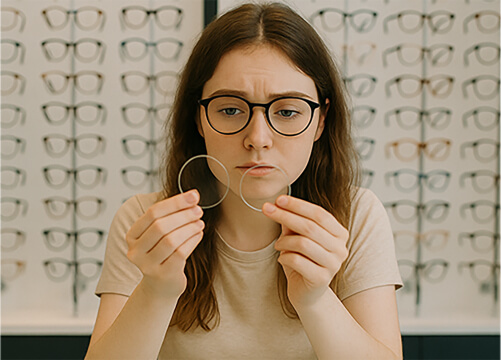
If you wear glasses, you’ve probably experienced “lens choice paralysis.” With so many options—glass, nylon, resin, PVC, refractive indexes like 1.56, 1.61, 1.67—which one is right for you? Let’s break it down.
Lens Materials
1. Glass Lenses
Made from optical glass, these lenses have excellent optical performance and a high refractive index, meaning thinner lenses for the same prescription. However, they’re heavy, fragile, and harder to maintain. For everyday use, they’re not the most practical choice.
2. PVC Plastic Lenses
These are made from thermoplastic materials. While they’re cheap, they have poor light transmission, low heat resistance, and deform easily. They’re mostly used for decorative or costume glasses—not recommended for daily wear.
3. Nylon Lenses
Made from transparent polyamide, nylon lenses were originally developed for astronaut helmets, military protection gear, and precision instruments. They’re strong, lightweight, and expensive. Today, they’re found in high-end sports and luxury sunglasses. Be cautious—many low-cost “nylon” lenses on the market are actually polyamide imitations.
4. Resin Lenses
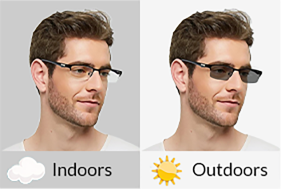
The most common choice today. Resin lenses are lightweight, impact-resistant, and have excellent transparency. Coated versions offer water resistance, scratch resistance, UV protection, blue light filtering, and even photochromic properties. Most optical shops sell resin lenses as their primary product.
Spherical vs. Aspheric Lenses
Spherical lenses have a uniform curvature but can cause image distortion, reduced clarity, and narrower fields of vision.
Aspheric lenses have a more advanced curvature design, reducing distortion and providing:
· Sharper vision – clearer and more comfortable.
· Lightweight comfort – thinner and lighter for better wearability.
· Natural appearance – less magnification or minification, more realistic vision.
For a modern, comfortable, and aesthetically pleasing experience, aspheric lenses are the recommended choice.
Understanding Lens Refractive Index
You’ll often see numbers like 1.57, 1.61, 1.67 when choosing lenses. This refers to the refractive index—the higher the number, the thinner the lens for the same prescription.
· 1.56 – Best for low prescriptions (below -2.00)
· 1.61 – Suitable for medium prescriptions (-2.00 to -4.00)
· 1.67 – Ideal for high prescriptions (-5.00 and above)
Higher refractive index lenses are lighter and more attractive but also more expensive. Additionally, for the same index, aspheric lenses will always be thinner than spherical ones.
Final Recommendation
For most people, the best all-round choice is aspheric, coated resin optical lenses—a balance of comfort, durability, clarity, and cost-effectiveness. If budget isn’t a concern, premium materials like nylon or specialized coatings are also an option.
If you’re shopping online, buyglasses.com offers factory-direct aspheric lenses at affordable prices, with many premium coatings included for free.

20
This article was written by the buyglasses.com team. Buy glasses at factory prices on buyglasses.com.