













Understanding Astigmatism: Causes, Symptoms, and How to Treat It
astigmatism, what is astigmatism, astigmatism causes, astigmatism symptoms
Discover what astigmatism really is, its causes, common symptoms, and treatment methods.
Understanding Astigmatism: Causes, Symptoms, and How to Treat It
Many people who wear glasses have heard the term “astigmatism,” but few truly understand what it means. Is it the same as myopia (nearsightedness)? How does it develop? Can it get worse over time or even disappear on its own? Do you have to wear glasses forever if you have it?
Astigmatism occurs when the curvature of the cornea or lens is uneven, with most cases originating from the cornea. This article focuses on corneal astigmatism, explaining its causes, symptoms, and treatment options to help clear up common questions.
Causes of Astigmatism
The eye works much like a camera, with the cornea acting as the lens. When light passes through the cornea, it refracts and focuses onto the retina, producing a clear image—just as a camera lens focuses light onto film.
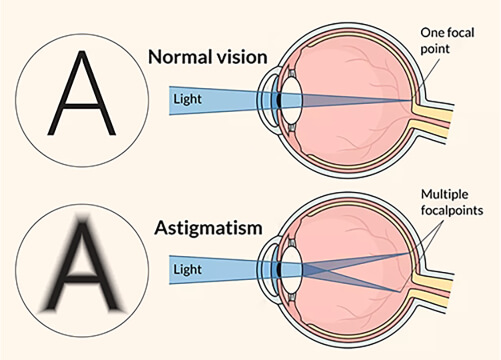
In a normal eye, the surface of the cornea (the main refractive surface) is spherical, with the same curvature in all directions—like a basketball—allowing light to focus precisely on the retina.
In an eye with astigmatism, the cornea’s curvature is uneven, more like the shape of a rugby ball. For example, the horizontal curve may be flatter, causing the image to focus in front of the retina, while the vertical curve is steeper, focusing the image behind the retina. This mismatch means light in different meridians focuses at different points, creating multiple focal points instead of one. The result? Blurred or distorted vision.
Astigmatism is extremely common—over 90% of people have it to some degree, with around 10–20% having more than 1.00 diopter. It is more prevalent among Asian populations. Studies in Hong Kong show that one in two people needing vision correction also has astigmatism. Most cases are congenital and unrelated to prolonged reading or computer use.
In most people, astigmatism remains stable over time, unlike myopia, which often progresses with age. However, certain eye conditions—such as keratoconus—can cause astigmatism to worsen.
Symptoms of Astigmatism
Astigmatism affects both near and distance vision. Common symptoms include:
· Blurry or distorted vision at all distances
· Light sources appearing to “spread out” or have a halo
· Double or “ghost” images
· Worsened vision in low light
· Eye strain, headaches, or dizziness
In children, uncorrected astigmatism over 1.00 diopter can lead to amblyopia (lazy eye) or rapid myopia progression, as the brain fails to receive clear images during visual development.
How to Correct Astigmatism
Non-surgical treatments:
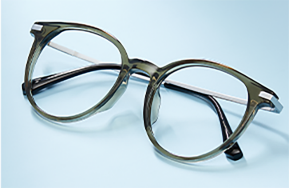
· Eyeglasses: The most common, safe, and effective option.
· Contact lenses: Toric soft lenses or rigid gas-permeable (RGP) lenses can correct astigmatism. While effective, contact lenses carry higher risks such as corneal hypoxia and require strict cleaning and care (cleaning, disinfecting, and protein removal).
Surgical treatments: The most common, safe, and effective option.
For severe cases where glasses or contact lenses fail to provide satisfactory vision, surgical options such as LASIK or other refractive procedures can reshape the cornea and correct astigmatism.
Key Takeaways:
· Astigmatism is caused by uneven corneal or lens curvature.
· Most cases are stable, but certain conditions can worsen it.
· Moderate to high astigmatism should be corrected to avoid vision problems.
· Treatment includes glasses, contact lenses, and surgical correction.

20
This article was written by the buyglasses.com team. Buy glasses at factory prices on buyglasses.com.